Dream Destination: Mekong Delta, Vietnam — When You Need to See What a River Looks Like When It Becomes a Civilization
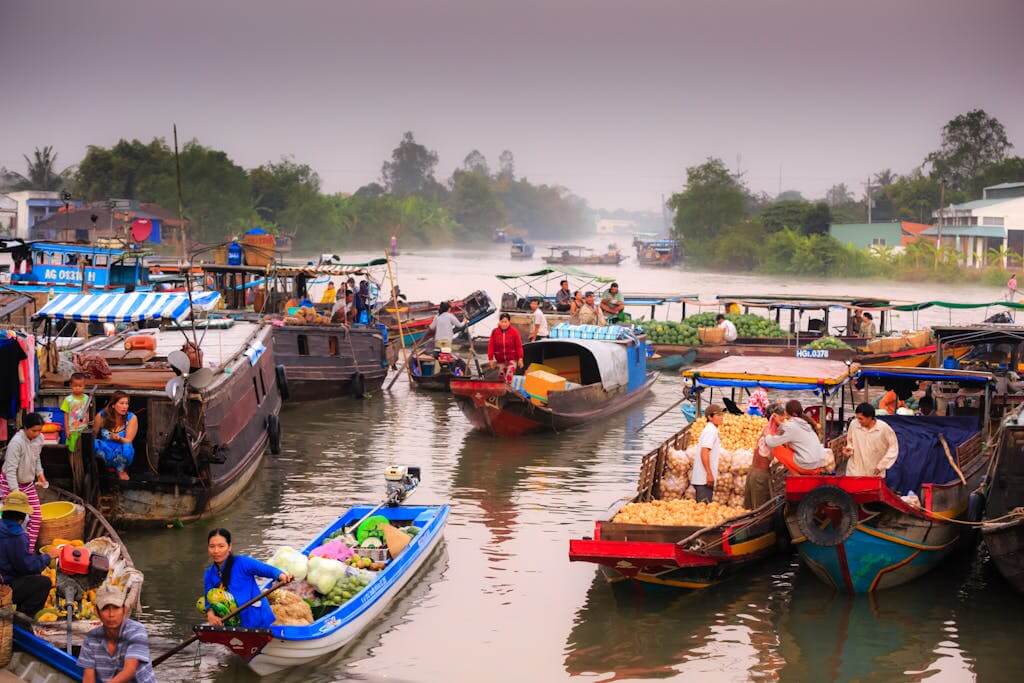
Photo by Quang Nguyen Vinh @pexelsphoto
The Mekong Delta Vietnam tour is not a place. It’s a river system that became a way of life.
This dream destination is where the Mekong River—after traveling 4,350 kilometers through China, Myanmar, Laos, Thailand, and Cambodia—finally fractures into nine tributaries (the “Nine Dragons”) and floods southern Vietnam with the sediment that feeds 20 million people.
This is Vietnam’s rice bowl. Its fruit basket. Its fish farm. This is where 50% of the country’s rice comes from, where coconut candy factories line canals, where floating markets have operated for centuries, where entire villages live on water because land is negotiable but the river is constant.
You don’t visit the Mekong Delta. You float through it—on boats, through canals so narrow the jungle scrapes both sides, past houses on stilts, past women rowing boats loaded with pineapples, past children waving from wooden docks, past a version of Vietnam that exists because the river allows it.
The Mekong Delta is 90 minutes to 3 hours southwest of Ho Chi Minh City (depending on your destination), but it feels like a different country—slower, greener, wetter, louder with cicadas and boat motors instead of motorbikes.
You arrive in towns like Mỹ Tho, Cần Thơ, Vĩnh Long, Bến Tre, or Châu Đốc—gateways to a network of rivers, canals, and islands where daily life happens on water, where markets float, where boats replace cars, and where the river dictates everything—farming seasons, transportation, commerce, survival.
This is not resort Vietnam. This is not beach Vietnam. This is working Vietnam—muddy, humid, relentless, beautiful in ways that don’t fit Instagram filters.
The Mekong Delta won’t charm you with temples or pristine beaches. It’ll show you what happens when humans and a river negotiate for a thousand years—and both win.
⚠️ Essentials for Tourist: Mandatory Digital Arrival Card (2026). As of April 15, 2026, all international travelers arriving at Ho Chi Minh City (Tan Son Nhat – SGN) must submit a Vietnam Digital Arrival Card online via the official portal (prearrival.immigration.gov.vn) up to 72 hours before landing.
For the ones who feel the pull – this Mekong Delta Vietnam tour is your RESET
If you need luxury hotels or nightlife, the Mekong Delta will disappoint you.
If you need to see what a river looks like when 20 million people depend on it daily, when markets float because land is scarce, when fruit grows so abundantly it becomes industrial—the Mekong Delta is essential.
This dream destination was built for:
- Travelers who want to see how Vietnam actually lives—agriculture, river commerce, village life River lovers ready for boat rides through jungle canals and floating markets at dawn
- Food curious explorers who want to see where rice, tropical fruit, and fish come from before they hit the table
- Photographers chasing river light, floating markets, farmers in conical hats working rice paddies
- Slow travelers who understand that the Delta rewards multiple days, not rushed day trips
- Anyone tired of cities who needs green, water, and the rhythm of a place that wakes with the river
- Cultural observers ready to witness a civilization built on flood cycles, not concrete
When the world finally exhales, what it feels like
The Geography – Because the Delta Is the River
- The Mekong River splits into nine main distributaries before reaching the sea: Tiền Giang (Front River) and Hậu Giang (Back River) are the two largest, with seven smaller branches spreading across 12 provinces.
- The land is flat—highest point maybe 3 meters above sea level. Everything floods during rainy season (May–November). Rice paddies stretch to the horizon. Canals thread through coconut groves. Islands appear and disappear with the water level.
- This is amphibious geography—neither fully land nor fully water, but something in between that humans learned to navigate.
The Floating Markets: Dawn Rituals, River Commerce
- This is why most people come to the Delta—and you need to wake up at 4:30 AM to see them properly.
Can Tho—Cai Rang Floating Market: Largest, Most Famous
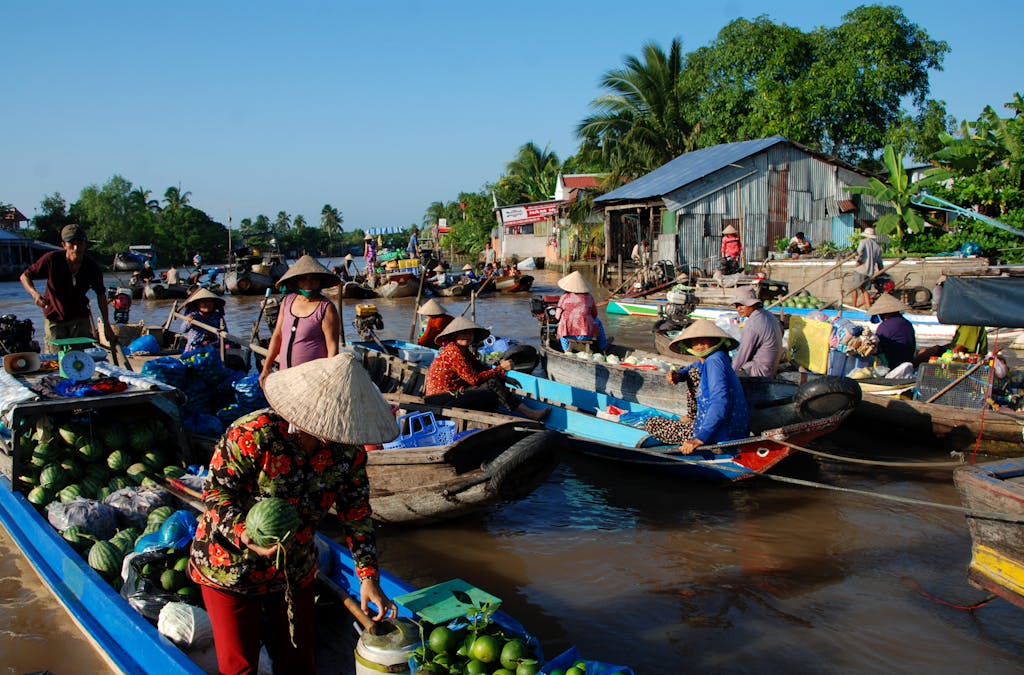
Photo by Tom D’Arby @pexelsphoto
- You hire a boat (₫150,000–300,000/$6–12 per person, 2–3 hours) at 5 AM from Cần Thơ (the Delta’s largest city, 3.5 hours from HCMC).
- You motor through darkness. The sky lightens. The river fills with boats.
- Not tourist boats—wholesale boats. Farmers selling directly from their vessels. Each boat hangs a long pole (cây bẹo) with samples of what they’re selling: pineapples, watermelons, dragon fruit, yams, onions, cabbage.
- You float through a market that’s been operating since before trucks existed. Vendors row smaller boats between the big ones, buying in bulk. Coffee boats serve cà phê sữa đá directly to customers floating by (₫15,000/$0.60). Noodle boats sell hủ tiếu (southern Vietnamese noodle soup) for breakfast (₫30,000/$1.20).
- By 9 AM, the market dissolves—farmers motor home, goods sold, river emptying until tomorrow.
- This isn’t performed for tourists. Tourists are incidental. The market exists because the river is the highway and boats are trucks.
Phong Dien Floating Market: Smaller, More Intimate
- 30 minutes from Cần Thơ, fewer boats, more local, less touristy. If Cái Răng feels too big, this is the alternative.
Long Xuyen Floating Market
- Near Châu Đốc, early morning, almost no foreign tourists. You’ll be one of few non-Vietnamese.
The Canal Experience: Narrow Waterways, Jungle Canals
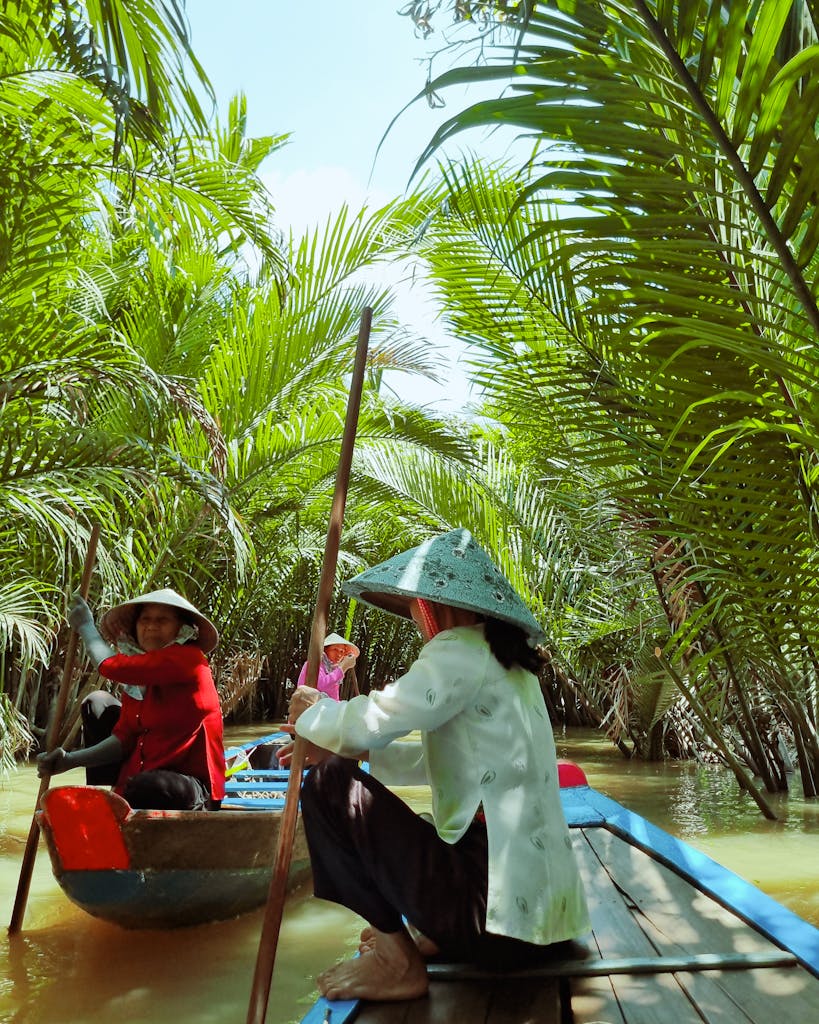
Photo by Rushikesh Patil @pexelsphoto
After the floating market, boats take you into canals—narrow channels cutting through coconut groves, fruit orchards, and villages.
The canals are 2–4 meters wide. Jungle presses in from both sides. You duck under low bridges. You pass houses on stilts. Children wave. Women wash clothes in the river. Old men fish with handlines.
This is the Delta’s back roads—except the roads are water.
You stop at:
Coconut candy workshops
- Small family factories making kẹo dừa (coconut candy). You watch workers stir massive woks of coconut milk and sugar, cut the candy by hand, wrap it in rice paper. You taste it fresh. You buy bags for ₫50,000 ($2). It’s better than any version you’ll find in the city.
Fruit orchards—longan, rambutan, mangosteen, dragon fruit farms
- You walk wooden planks between trees. Farmers let you pick and eat. You pay ₫50,000 ($2) for unlimited tropical fruit and leave sticky and happy.
Rice paper workshops
- Watching workers make bánh tráng (rice paper) by hand—spreading batter thin on bamboo mats, steaming, drying in the sun.
Honey farms
- Local honey production, tasting, bee demonstrations that make you nervous.
- These aren’t attractions. They’re workshops—actual production facilities that happen to let tourists watch because tourism provides supplemental income.
Staying on the river: Homestays, Floating Life
The best Delta experiences require overnight stays—not day trips from HCMC.
Homestays
(₫200,000–400,000/$8–16 per person with meals)
- You stay with Delta families—stilted houses, river views, home-cooked meals (spring rolls you help make, fish caught that morning, tropical fruit desserts).
- Dinner is communal. You eat with the family. They speak broken English or none. You communicate with gestures and smiles. You sleep under mosquito nets. You wake to roosters and river sounds.
- This is not comfort. This is immersion.
- BẾN TRE HOMESTAYS (Coconut Province): Known for coconut everything—coconut candy, coconut wine, coconut groves. Homestays here emphasize coconut culture.
- AN BÌNH ISLAND (near Vĩnh Long): Quiet island, fruit orchards, cycling paths, homestays surrounded by green.
- CHÂU ĐỐC (near Cambodian border): Floating houses, fish farms beneath homes, sunrise over Sam Mountain, Muslim Cham communities, cultural diversity.
What you can actually do in Mekong Delta
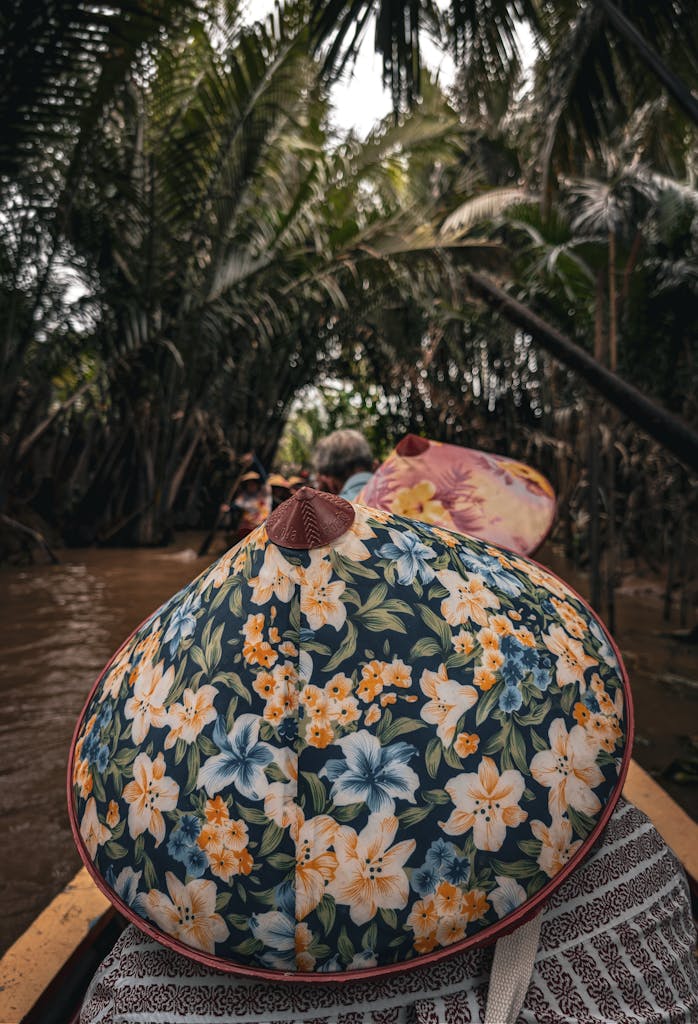
Photo by Nirjhar Basak @pexelsphoto
- Early Morning:
- Wake at 4:30 AM for floating market boat tour
- Eat breakfast on a boat (noodle soup, coffee)
- Photograph river commerce in golden hour light
- Mid-morning to Afternoon:
- Navigate narrow canals through coconut groves
- Visit fruit orchards, coconut candy workshops, rice paper makers
- Bicycle through rice paddies and villages (flat terrain, easy riding)
- Visit pagodas and temples (Vĩnh Tràng Pagoda in Mỹ Tho, Khmer pagodas in Trà Vinh)
- Late Afternoon:
- Watch sunset over rice fields
- Help homestay family prepare dinner (spring rolls, fish)
- Evening boat rides (quieter, locals fishing, kids swimming)
- Evening:
- Communal dinner with homestay family
- Traditional music (if arranged—đờn ca tài tử, southern folk music)
- Early sleep (you woke up at 4:30 AM, you’re exhausted, and tomorrow starts early again)
The quite reasons you’ll find your way back
This dream destination doesn’t try to impress you with monuments or beaches. It just shows you: this is what happens when a river becomes infrastructure, economy, and culture simultaneously.
First-timers do day trips and regret not staying longer. Second-timers stay overnight and realize the Delta rewards multiple days. Third-timers understand that the Delta isn’t a destination—it’s a rhythm, and you either sync with the river or miss the point entirely.
The Mekong Delta becomes less a checklist item and more an understanding: this is how 20 million people survive, thrive, and build lives on water that refuses to stay still.
Because the Mekong Delta, Vietnam is:
- Working Vietnam—not performing for tourists, just being Vietnam
- River civilization—you can’t understand the Mekong without seeing it feed millions
- Visually layered—rice paddies, fruit orchards, floating markets, jungle canals, endless green
- Culturally essential—this is where Vietnamese agriculture happens, where food comes from
- A pace-changer—after Saigon’s motorbike chaos, the Delta forces you to slow down
What this place whispers to your heart – the emotional promise
You’ll wake before dawn and motor through a floating market while the sky turns gold. You’ll bite into dragon fruit picked thirty seconds ago and understand what “fresh” actually means. You’ll help a homestay grandmother make spring rolls and eat dinner while her granddaughter practices English on you.
The Mekong Delta won’t pamper you. But it’ll show you what resilience looks like when it’s agricultural—when entire provinces flood annually and people just build higher, farm differently, and keep going.
And that groundedness, that acceptance of the river’s terms—it recalibrates what you think “difficult” means.
This is the kind of place you bring:
- Your city exhaustion when you need green, water, and a pace tied to daylight instead of deadlines
- Your curiosity about where food actually comes from before supermarkets
- Your willingness to be uncomfortable—humidity, mosquitoes, squat toilets, language barriers
- Your camera for river light, floating markets, and landscapes that look painted
- Yourself when you’re ready to witness work, not performance
What follows you home – after you leave
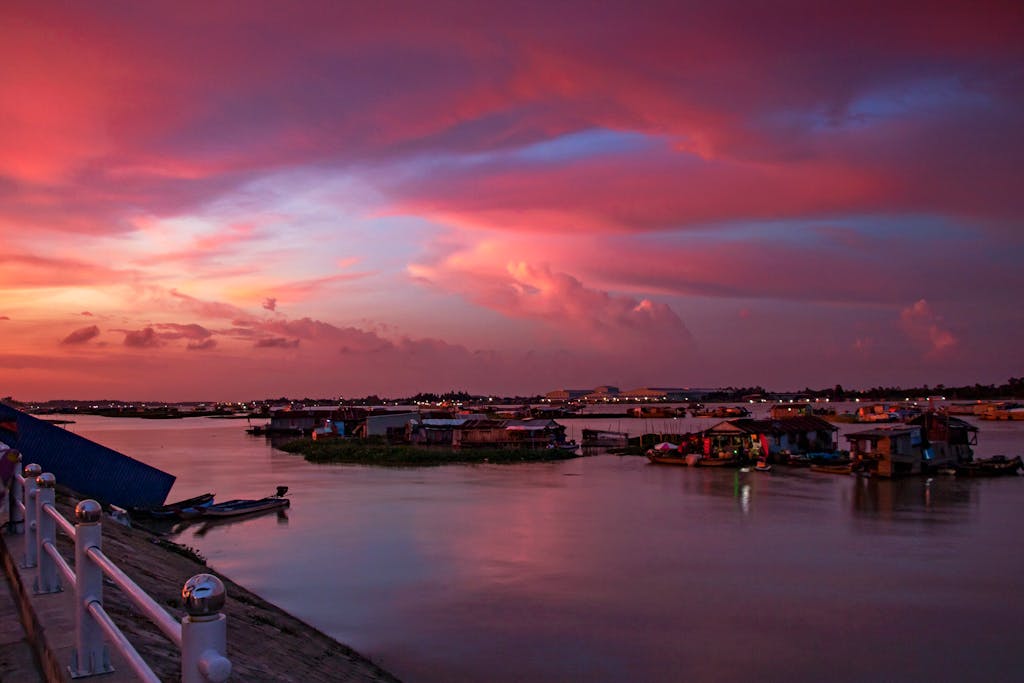
Photo by Văn Long Bùi @pexelsphoto
You’ll return to Ho Chi Minh City or fly onward, and the concrete will feel strange after three days of water and green.
You’ll remember: the floating market at dawn. The canal so narrow jungle touched both sides. The homestay grandmother who fed you like family even though you couldn’t speak each other’s language.
Some people leave the Mekong Delta and immediately plan deeper trips—Châu Đốc, Hà Tiên, the Cambodian border. Some people leave and realize they needed the river’s pace to appreciate the city’s chaos again. Some people leave and carry the Delta as proof that some civilizations are built with nature instead of against it.
All three are valid.
What matters is this: you saw what the Mekong River looks like when it becomes a civilization. Not abstracted. Not from textbooks. Floating. Working. Feeding millions. And once you’ve floated through that—you understand Vietnam differently.
How long you can linger, and what it really cost
⌛Time:
- Day trip from HCMC—possible (Mỹ Tho/Bến Tre), rushed, misses the rhythm, defeats the purpose
- 2D1N minimum—floating market + canals + homestay, proper introduction
- 3D2N ideal—multiple markets, deeper canals, bicycle exploration, actual immersion
- 4D3N+—multiple towns (Cần Thơ, Bến Tre, Châu Đốc), slower pace, river rhythm settles in
💸Budget Range:
- Budget tour from HCMC: ₫600,000–1,200,000 per person ($25–50, day trip)
- Group tour, bus, Mỹ Tho/Bến Tre, boat ride, fruit tasting, lunch, back by 6 PM, surface-level
- Independent budget (2D1N): ₫800,000–1,500,000 per person ($32–60)
- Bus to Cần Thơ (₫150,000), budget hotel (₫200,000/night), floating market boat tour (₫200,000), street food (₫150,000/day), local transport, self-guided
- Comfortable homestay experience (2D1N): ₫1,500,000–2,500,000 per person ($60–100)
- Private car/van from HCMC, homestay with meals (₫400,000/person), floating market tour, canal exploration, fruit orchards, bicycle rental, English-speaking guide
- Multi-day deep dive (3D2N): ₫2,500,000–4,500,000 per person ($100–180)
- Private transport, mix of homestays and mid-range hotels, multiple floating markets, Châu Đốc + Cần Thơ, cooking class, traditional music performance, full immersion
🧳The Mekong Delta is affordable—street food is cheap, homestays are budget-friendly, and you can experience it well on $40–60/day.
🚣🏾♀️If the Mekong Delta feels like the Vietnam you needed, your next chapter might be ⤵️
The Dream Map Travel Destinations grows one story at a time.
It’s a collection of lived moments—routes taken on a whim, places that surprised you, detours that turned into stories worth keeping.
Every Dream Map travel destinations exists because someone went first.
If you’ve been there—
reached a place you didn’t expect to love
discovered a route that felt smoother than advertised
stayed longer than planned because the place earned it.
share it below.
Your experience doesn’t have to be perfect. It just has to be real.
What you add helps future travelers imagine better, plan smarter, and arrive with context instead of fantasy.
Dream Map travel destinations grows one story at a time—quietly, collectively, and with intention
This page evolves with shared experiences. Verified patterns are folded back into the map over time.
MappedAtlas improves with commuter reports. If you find outdated routes, changed timetables, or new paths, send a quick update.
Last updated: March 2026