Beijing, China — When You Need to Stand Before 5,000 Years and Understand That Empires Aren’t Metaphors
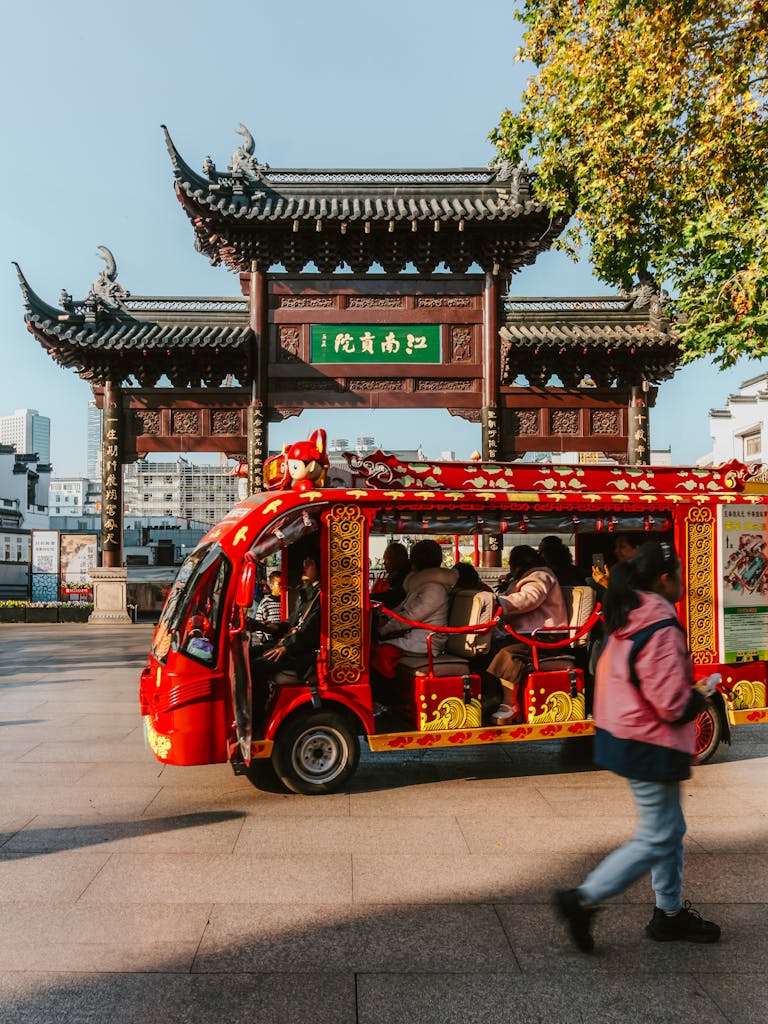
Photo by Abderrahmane Habibi @pexelsphoto
Beijing China tour doesn’t ask for your attention. It commands it.
This dream destination is the capital of the world’s most populous nation, a city of 22 million people where 3,000 years of dynastic history meets Communist monuments meets capitalist skyscrapers meets technology that makes other “smart cities” look quaint.
Beijing (北京, Běijīng—”Northern Capital”) has been the seat of Chinese power for 800+ years—through Yuan, Ming, Qing dynasties, through invasion, revolution, famine, and the fastest economic rise in human history.
This is where the Forbidden City hid emperors for 500 years behind walls so massive you can’t see the end. Where Tiananmen Square holds a million people and the weight of 1989. Where the Great Wall snakes across mountains 70 kilometers north like a dragon made of stone and human bones. Where hutongs (narrow alleyways) still function as neighborhoods while glass towers erase the skyline daily.
You arrive at Beijing Capital International Airport (or the newer Daxing, which looks like a spaceship designed by Zaha Hadid), take the subway or taxi into a city that hits you with scale—roads so wide they need 8 lanes, buildings so tall they disappear into smog, history so deep you’re walking on 20 layers of previous cities.
Beijing is not charming. It’s not cozy. It’s not the China of rice terraces and temples.
This is the capital that built walls to keep out invaders, then opened the gates and became the world’s factory, financier, and future.
You don’t visit Beijing, China to relax.
You come because some cities demand to be witnessed—because standing in Tiananmen Square at sunrise, or climbing the Great Wall at Mutianyu, or walking through the Forbidden City’s 980 buildings isn’t tourism. It’s reckoning with the fact that while your country was being founded, this empire was already ancient.
⚠️ Essentials for Tourist: Until December 31, 2026, ordinary passport holders from roughly 50 countries (including many EU nations, Japan, and South Korea) can enter China visa-free for up to 30 days. Visa (tourist L) or 144hr transit | [visaforchina.org](https://www.visaforchina.cn) or through local Chinese embassy
For the ones who feel the pull – this Beijing China tour is your EDGE
If you need beaches or tropical ease, Beijing will frustrate you—it’s landlocked, dry, cold in winter, hot in summer.
If you need to stand before history so massive it rewires your understanding of “old,” if you need food culture as deep as any on Earth, if you need to see what a civilization looks like when it’s been continuous for 5,000 years—Beijing is non-negotiable.
This dream destination was built for:
- History lovers ready to stand in front of imperial palaces that make European castles look like cottages
- Great Wall pilgrims who need to see it in person because photos don’t hold the scale
- Political observers trying to understand modern China by walking where emperors walked and where Mao’s portrait still hangs
- Food adventurers ready for Peking duck, dumplings, street snacks, and cuisines from every Chinese province
- Architecture nerds who want to see what happens when imperial, Soviet, and ultramodern architecture occupy the same city
- First-time China travelers who want a city with infrastructure that works, English signage (sometimes), and iconic sites
- Anyone who understands that some capitals aren’t just political centers—they’re civilizational statements
When the world finally exhales, what it feels like
THE HISTORIC HEART (Forbidden City, Tiananmen, Imperial Core)
TIANANMEN SQUARE (天安门广场)
- The world’s largest public square—440,000 square meters, capacity 1 million people.
- You arrive early morning (6 AM) for the flag-raising ceremony. Thousands of Chinese tourists watch soldiers march in perfect formation. The national anthem plays. The flag rises. Grown men cry.
- The square is vast. Empty of personality, full of symbolism:
- Mao’s Mausoleum—his embalmed body lies here (lines long, closed afternoons, restrictions heavy)
- Monument to the People’s Heroes—obelisk commemorating revolutionary martyrs
- Great Hall of the People—where the National People’s Congress meets
- National Museum of China—one of the world’s largest museums (free, massive collections)
- And watching over it all: Mao Zedong’s portrait on the Gate of Heavenly Peace (Tiananmen).
- This square is where dynasties were proclaimed, where the People’s Republic was founded (1949), where the protests of 1989 happened (not discussed in China, heavily censored).
- The air is heavy here—not with smog (though that too), but with weight.
THE FORBIDDEN CITY (故宫, Gùgōng—Former Palace)
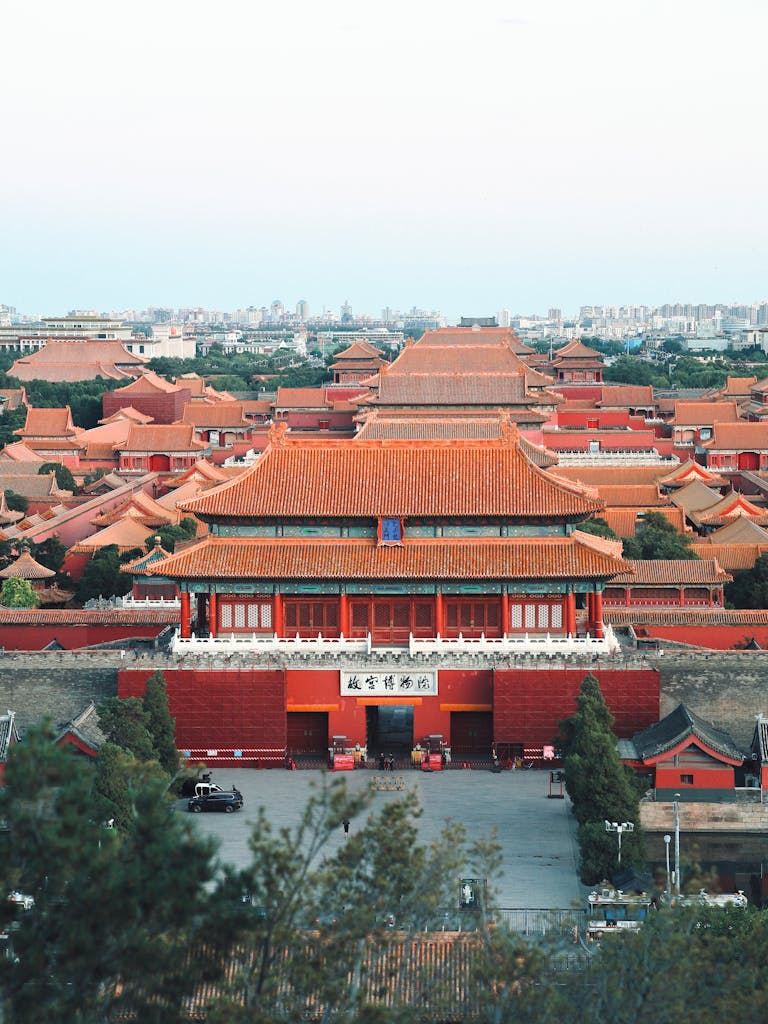
Photo by shaozu peng @pexelsphoto
- You enter through Tiananmen Gate, walk across moats and through massive wooden gates into the largest imperial palace complex on Earth.
- 980 buildings. 9,000+ rooms. 720,000 square meters.
- For 500 years (1420–1912), 24 emperors lived here. Commoners couldn’t enter on pain of death—hence “Forbidden.”
- You walk the central axis:
- Gate of Supreme Harmony—the entrance proper
- Hall of Supreme Harmony—largest wooden structure in China, where emperors were crowned
- Hall of Central Harmony—where emperors prepared for ceremonies
- Hall of Preserving Harmony—where imperial exams were held
- The scale is overwhelming. Hall after hall. Courtyard after courtyard. Red walls. Golden roofs. Dragon motifs everywhere (the emperor was the “Son of Heaven,” symbolized by dragons).
- You walk where emperors walked. Where concubines lived in the inner courts. Where eunuchs served. Where power so absolute it’s hard to imagine today was exercised daily.
- By the end, you’re exhausted—not from walking (though it’s 2–3 hours minimum), but from the density of history.
- Budget 4–6 hours. Arrive when it opens (8:30 AM) to beat crowds. Buy tickets online in advance (₽60 in low season, ₽80 in high season/$8–11).
JINGSHAN PARK (景山公园)
- Directly north of the Forbidden City, a man-made hill where you climb for panoramic views over the palace complex.
- Sunset here is magic—the golden roofs glow, the city spreads in every direction, and you realize: the Forbidden City is massive, and it’s just one piece of Beijing.
TEMPLE OF HEAVEN (天坛, Tiāntán)
- Where emperors performed annual ceremonies to pray for good harvests.
- The Hall of Prayer for Good Harvests—circular, wooden, triple-roofed, iconic—is one of China’s most recognizable structures.
- The park around it is where locals gather—tai chi, calligraphy practice on pavement with water brushes, dancing, badminton, card games. This is Beijing’s living room.
- Entry: ₽15 park only, ₽34 with buildings ($2–5).
THE GREAT WALL (长城, Chángchéng)
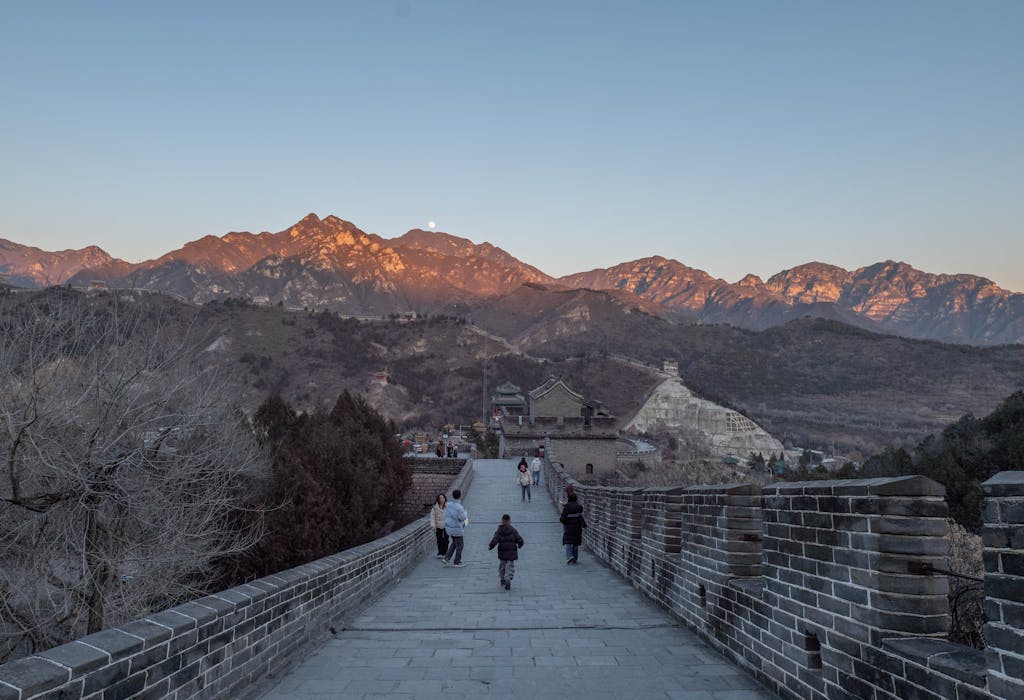
Photo by Rain Lü @pexelsphoto
You cannot come to Beijing without seeing the Great Wall of China—21,000+ kilometers of fortifications built over 2,000+ years to protect China from northern invasions.
The wall near Beijing has several accessible sections:
BADALING (八达岭)—Most Famous, Most Crowded
- 70km from Beijing, 1.5 hours drive Fully restored, cable car available, wheelchair accessible Crowded—Chinese tour groups, elbow-to-elbow in peak season Best for: first-timers, limited mobility, classic photos
MUTIANYU (慕田峪)—Best Balance
- 73km from Beijing, 2 hours drive Partially restored, less crowded than Badaling, more scenic Cable car or chairlift up, toboggan slide down (₽100/$14, absurdly fun) Best for: most travelers—easier than Jiankou, less crowded than Badaling
JIANKOU (箭扣)—Wild, Unrestored, Dangerous
- 73km from Beijing Unrestored—crumbling, steep, no safety rails, parts collapsed For experienced hikers only, not officially open (authorities tolerate it) Best for: adventurers, photographers, those who want the wall without restoration
SIMATAI (司马台)—Night Wall
- 120km from Beijing, 2.5 hours Only section open for night visits (lit up, atmospheric) Steep, dramatic, partially restored Best for: night photography, romance, avoiding day crowds
THE EXPERIENCE
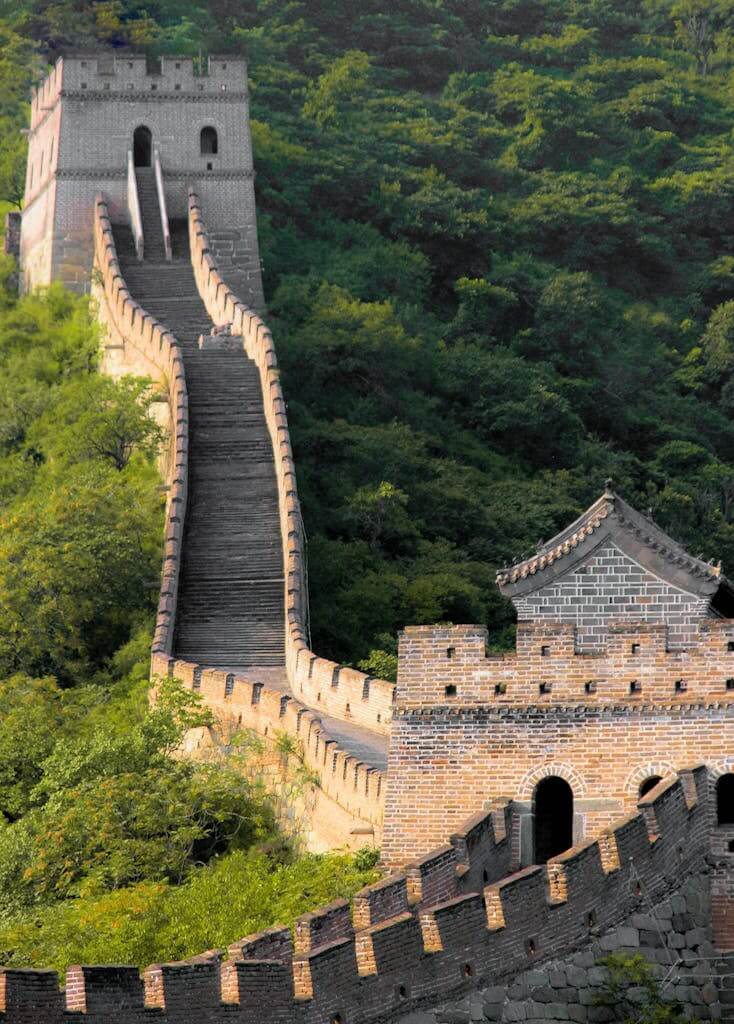
Photo by Michael Wright @pexelsphoto
- You arrive at Mutianyu (most common choice). You ride the chairlift up (₽100 one-way, ₽120 round-trip/$14–17). You step onto the wall.
- And the scale hits.
- The wall snakes across mountain ridges as far as you can see—watchtowers every few hundred meters, bricks worn by centuries, mountains stretching endlessly.
- You walk. The incline is steep—some sections 45°+. Your legs burn. You stop frequently, not from exhaustion but from awe.
- This wall was built by hand. Millions of workers. Thousands died. Their bodies were buried in the wall (urban legend, but emotionally true).
- And for all that effort, all that death—it didn’t work. The Mongols went around it. The Manchus were invited in by a Chinese general.
- The wall didn’t save China. But it became China’s symbol anyway—endurance, ambition, the willingness to attempt the impossible even if it fails.
- You ride the toboggan back down—a metal slide winding through forest, absurd and joyful and the perfect counterpoint to the wall’s gravitas.
- Budget a full day (8 AM–5 PM). Book tours (₽300–500/$42–70 with transport) or hire a driver (₽600–800/$84–112).
THE HUTONGS (胡同—Traditional Alleyways)
- Beijing isn’t just imperial palaces. It’s also hutongs—narrow alleyways lined with courtyard homes (siheyuan) where locals still live.
- Nanluoguxiang (南锣鼓巷)—most famous hutong street, touristy but beautiful, cafés and boutiques in restored courtyards.
- Dashilar (大栅栏)—south of Tiananmen, mix of tourists and locals, traditional shops, Peking opera theaters.
- Gulou (Drum Tower) area—less touristy, actual residential hutongs, bell and drum towers (climbed for views).
- You walk these alleys and see:
- Elderly men sitting outside playing chess
- Communal toilets (hutongs predate indoor plumbing)
- Courtyards where multiple families share space (post-Communist redistribution)
- Gentrification—hutongs being demolished for high-rises, or preserved and monetized
- The hutongs are Beijing’s living memory—what the city was before Communism, before glass towers, before the modern superpower.
- They’re disappearing. Walk them while you can.
MODERN BEIJING (The City of Tomorrow)
798 ART DISTRICT (798艺术区)
- Former industrial complex (Factory 798, built with Soviet help in the 1950s), now contemporary art galleries, cafés, boutiques.
- Bauhaus architecture meets Chinese avant-garde art. Galleries range from experimental to commercial. Weekends are crowded.
- This is where Beijing’s creative class exists—carefully, under state oversight, pushing boundaries when possible.
CCTV TOWER (央视大楼)
- Nicknamed “Big Pants”—Rem Koolhaas-designed, structurally impossible-looking, iconic skyline feature.
- You can’t enter (it’s a TV station), but it’s a symbol of modern Beijing—bold, expensive, impossible to ignore.
SANLITUN (三里屯)
- Beijing’s nightlife/shopping district. International brands, bars, clubs, expats, wealthy Chinese youth.
- This is the Beijing that parties, shops, drinks ₽80 cocktails ($11), and speaks English.
BEIJING FOOD CULTURE
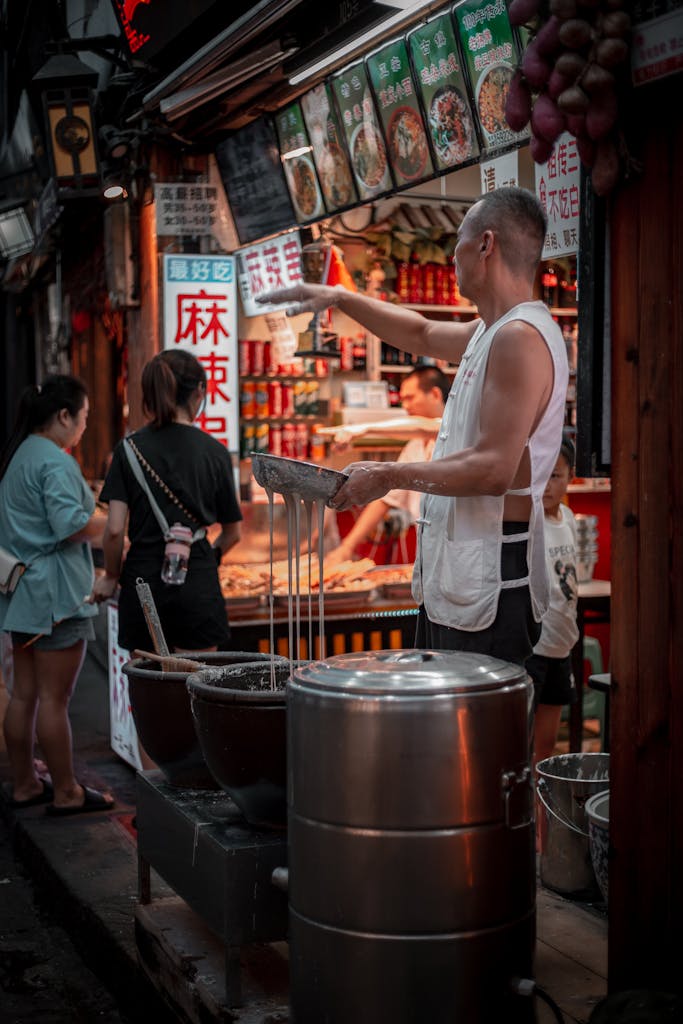
Photo by Zekai Zhu @pexelsphoto
Beijing is China’s capital—which means every regional cuisine is represented.
Must-eats:
- Peking Duck (北京烤鸭, Běijīng Kǎoyā)—the city’s signature dish:
- Quanjude (全聚德)—most famous, touristy, expensive (₽300–500/duck, $42–70), still excellent
- Bianyifang (便宜坊)—older (1416), locals prefer it, cheaper (₽200–300/$28–42)
- Served with thin pancakes, scallions, hoisin sauce. Crispy skin, tender meat, ritual carving.
- Dumplings (饺子, Jiǎozi):
- Din Tai Fung—Taiwanese chain, soup dumplings (xiaolongbao), reliable
- Street dumpling shops—₽15–30 for a plate ($2–4)
- Jianbing (煎饼)—Beijing breakfast crepe:
- Egg, crispy wonton, scallions, cilantro, hoisin sauce, chili sauce, folded
- Street vendors, ₽8–15 ($1–2), eaten while walking
- Zhajiangmian (炸酱面)—Noodles with fermented soybean paste:
- Beijing soul food, ₽20–35 ($3–5), comfort in a bowl
- Lamb skewers (羊肉串, Yángròu chuàn)—Muslim Quarter (Niujie), grilled, cumin-spiced
- Hot pot (火锅, Huǒguō)—northern style, spicy, communal
- Street snacks:
- Tanghulu (糖葫芦)—candied hawthorn berries on sticks
- Baozi (包子)—steamed buns, various fillings
- Roujiamo (肉夹馍)—”Chinese hamburger,” shredded pork in flatbread
The quite reasons you’ll find your way back
This dream destination doesn’t charm you. It overwhelms you. First-timers hit the big sites (Forbidden City, Great Wall, Tiananmen) and leave stunned. Second-timers explore hutongs, try regional Chinese cuisines, visit lesser temples. Third-timers understand that Beijing isn’t a city—it’s a statement: “We were here before you, we’ll be here after, and we’re not asking permission.”
Beijing becomes less a destination and more a measuring stick for what “old” and “large” and “powerful” actually mean.
Because Beijing, China is:
- Historically essential—you cannot understand China without standing here
- Scale that defies comprehension—Forbidden City, Great Wall, Tiananmen—nothing prepares you
- Modern superpower HQ—this is where the 21st century is being negotiated
- Food capital—every Chinese cuisine represented, street to Michelin level
- Layered—imperial, Communist, capitalist, traditional, ultramodern all at once
What this place whispers to your heart – the emotional promise
You’ll stand in the Forbidden City and realize: emperors walked here for 500 years, and the complex is still mostly intact. You’ll climb the Great Wall at Mutianyu and see it snake across ridges until it disappears into mountains. You’ll sit in Tiananmen Square at dawn and feel the weight of revolutions, massacres, and empire compressed into stone.
Beijing won’t comfort you. But it’ll show you what a civilization looks like when it refuses to be erased—when invasion, colonization, revolution, famine, and war become chapters, not endings.
And that continuity, that imperial-to-Communist-to-capitalist arc condensed into one city—it’s staggering.
This is the kind of place you bring:
- Your assumptions about China when you’re ready to complicate them
- Your sense of history when you need to recalibrate what “ancient” means
- Your camera for walls snaking across mountains and palaces that take hours to cross
- Your appetite for Peking duck carved tableside and dumplings made by hand
- Yourself when you’re ready to feel small in front of 5,000 years of continuous civilization
What follows you home – after you leave
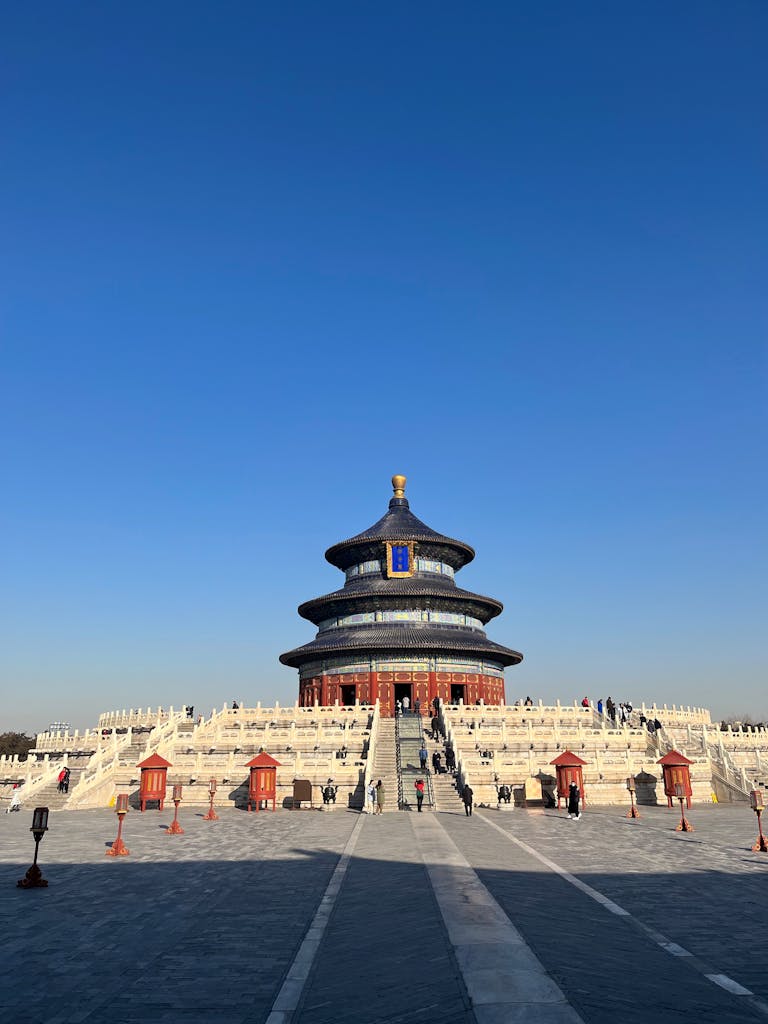
Photo by yan hui @pexelsphoto
You’ll leave Beijing, China and your sense of scale will be permanently altered.
The Forbidden City will make other palaces look quaint. The Great Wall will make other walls look decorative. Five thousand years of continuous civilization will make your own country’s history feel like a rough draft.
Some people leave and immediately plan deeper China trips—Xi’an, Shanghai, Guilin, Chengdu. Some people leave and realize they needed the weight of Beijing to appreciate lightness again. Some people leave and spend years unpacking what they saw—because Beijing isn’t a city you “get” in one visit.
All three are valid.
What matters is this: you stood at the center of the world’s oldest continuous civilization.
And once you’ve felt that—once you’ve walked where emperors walked, climbed walls built to keep out armies, stood in squares that hold a million people—you can’t pretend the world’s center is wherever you’re from.
Beijing showed you: the center has been here for 5,000 years. And it’s not moving.
How long you can linger, and what it really cost
⌛Time:
- 3D2N minimum—Forbidden City, Great Wall, Tiananmen, rushed
- 4D3N ideal—adds Temple of Heaven, hutongs, Peking duck dinner, breathing room
- 5D4N to 7D6N—multiple Great Wall sections, Summer Palace, 798 Art District, day trip to Ming Tombs, deeper exploration
💸Budget Range:
- Budget: ₽300–500/day ($42–70)
- Hostel (₽80–150/night, $11–21), street food (₽50–100/day, $7–14), subway (₽3–10/ride, $0.40–1.40), free/cheap sites, self-guided Great Wall trip
- Comfortable: ₽800–1,500/day ($112–210)
- 3-star hotel (₽300–600/night, $42–84), mix street + restaurant food (₽200–350/day, $28–49), taxis/Didi, Forbidden City + Great Wall tours, Peking duck splurge
- Upscale: ₽2,500+/day ($350+)
- Luxury hotel (₽1,000–3,000+/night, $140–420+), fine dining + street food, private car/driver, guided tours, premium Great Wall sections, VIP experiences
🧳Beijing is affordable by Western standards—street food is cheap, subways cost cents, even nice restaurants are reasonable. Your big costs: hotels and organized tours.
⚠️CRITICAL PRACTICAL INFO:
VPN REQUIRED:
- Google, Facebook, Instagram, WhatsApp, Gmail—all blocked
- Download VPN before arriving (ExpressVPN, NordVPN, Astrill)
- China’s firewall is real and total
VISA:
- Most nationalities need a visa (apply weeks in advance)
- 72-hour / 144-hour transit visa available for some nationalities (if transiting through Beijing to third country)
LANGUAGE BARRIER:
- English is limited outside tourist sites
- Download translation app with offline mode
- Have hotel address in Chinese characters
PAYMENT:
- Cash still works, but China is nearly cashless
- Alipay and WeChat Pay dominate—hard to set up as foreigner without Chinese bank account
- Credit cards work at hotels/major sites, not small shops
AIR QUALITY:
- Bring masks if sensitive
- Can be terrible (PM2.5 over 200 some days)
- Check AQI before visiting
- Winter (Dec–Feb) is worst
🚶🏾➡️If Beijing feels like the China you needed, your next chapter might be ⤵️
The Dream Map Travel Destinations grows one story at a time.
It’s a collection of lived moments—routes taken on a whim, places that surprised you, detours that turned into stories worth keeping.
Every Dream Map travel destinations exists because someone went first.
If you’ve been there—
reached a place you didn’t expect to love
discovered a route that felt smoother than advertised
stayed longer than planned because the place earned it.
share it below.
Your experience doesn’t have to be perfect. It just has to be real.
What you add helps future travelers imagine better, plan smarter, and arrive with context instead of fantasy.
Dream Map travel destinations grows one story at a time—quietly, collectively, and with intention
This page evolves with shared experiences. Verified patterns are folded back into the map over time.
MappedAtlas improves with commuter reports. If you find outdated routes, changed timetables, or new paths, send a quick update.
Last updated: March 2026