
PH Commute 101: First 24 Hours in Manila
This page provides the operational baseline for navigating the Philippines’ transit landscape. It is designed for first-time users—including students, job hunters, and foreign residents—requiring immediate functional literacy of the environment.
- Arrivals fail not because Metro Manila is hard, but because people make decisions too early, with too little context.
- Getting SIM, cash, and orientation right on arrival prevents blind movement. Blind movement leads to bad transport choices, wasted money, and missed appointments.
- Understanding the transport system at a high level—before diving into routes—prevents overload. You don’t need mastery on Day 1. You need direction.
- The first seven days determine whether your stay compounds or collapses. A simple, ordered roadmap reduces friction, preserves energy, and keeps your purpose on track.
- Scams and ripoffs target confusion, urgency, and unfamiliarity. Awareness isn’t paranoia—it’s cost control.
This page exists to replace guesswork with structure.
Structure turns a chaotic city into a usable system.
If you’re new to the system, start with the Commute framework to understand how modes connect.
If you’re unfamiliar with the area, confused by the layout, scan Street Logic by Area before moving.
If you already move regularly, use the Transit for operational details and current constraints.
Start Here: For First-Timers & Expats (The High-Reliability Path)
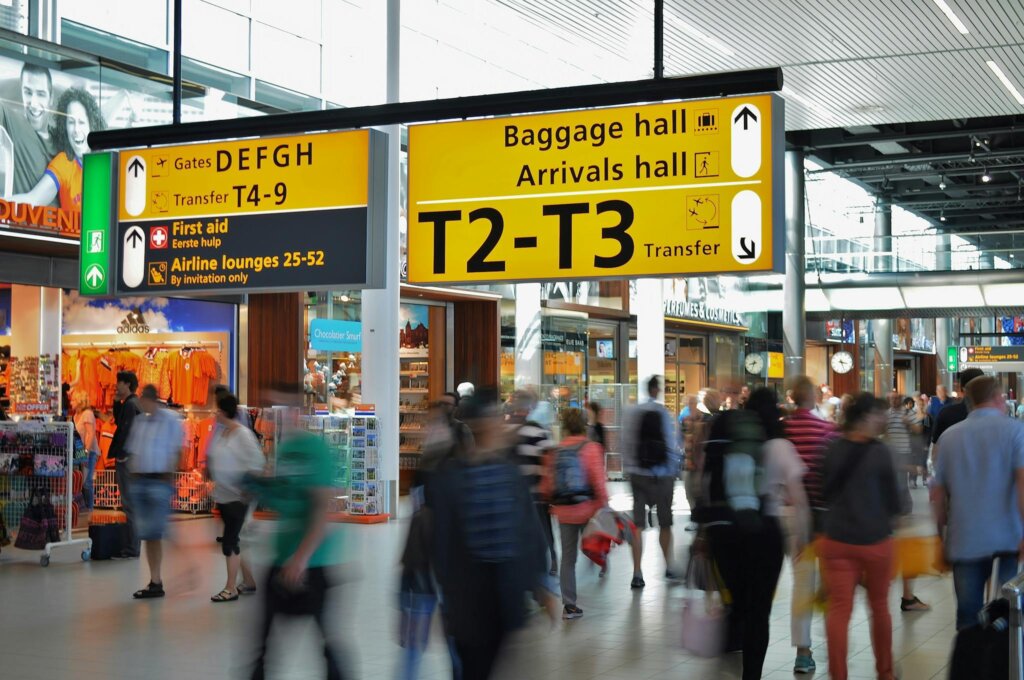
Expats and international travelers should prioritize predictability over cost-saving during their first week.
- Standardize on Grab: Use GrabCar for point-to-point travel until you understand the landmarks of your district.
- Use P2P (Point-to-Point) Buses: These offer fixed schedules and direct routes between major hubs (e.g., Makati to Ayala Malls Manila Bay) without intermediate stops.
- Avoid “White Taxis” at night: Stick to ride-hailing apps where the trip is GPS-tracked and the fare is predetermined.
Start Here: For Locals (Students & Job Hunters – The Efficiency Path)

Locals require cost-optimization and high-frequency routes.
- Student Discounts: Always carry a valid Student ID. You are legally entitled to a 20% discount on all public transport, including Grab and Trains.
- The UV Express Network: For job hunters traveling to business districts, UV Express vans are the middle ground—faster than jeepneys and cheaper than Grab.
- Rush Hour Strategy: 7:00 AM – 9:00 AM and 5:00 PM – 8:00 PM are “system-fail” hours. If your appointment is at 9:00 AM, aim to arrive at the vicinity by 7:30 AM.
Operational success in the first 24 hours depends on securing the two primary tools of Philippine transit: Information and Access.
Acquire a Beep Card: Purchase a stored-value “Beep” card at any LRT-1, LRT-2, or MRT-3 station teller. This card is the unified payment standard for all rail lines and the EDSA Carousel.
Install Core Utilities: Download Grab (Primary ride-hailing), Joyride/Angkas (Motorcycle taxi for gridlock), and Google Maps (Baseline routing).
Secure Small Denominations: Break ₱1,000 and ₱500 bills immediately. Jeepneys, tricycles, and buses often cannot provide change for large bills early in the shift.
Transit in the Philippines is segmented by “Distance Tiers.” Identify your destination distance to choose the correct mode:
| Distance Tier | Primary Mode | Secondary Mode |
| Micro ( < 2km) | Walking / Tricycle | E-Trike |
| Short (2km – 5km) | Jeepney / Modern PUV Grab / | Angkas |
| Medium (5km – 15km) | LRT / MRT / UV Express | Standard Bus |
| Long (15km +) | P2P Bus / EDSA Carousel | Provincial Bus |
DO: Keep bags in front. In any high-density vehicle (Jeepney, Train, Bus), wear your backpack on your chest.
DO: Use the “Para” Command. To stop a jeepney or bus, state “Para po” clearly. In jeepneys, tapping a coin on the metal handrail is also an accepted signal.
DO NOT: Display hardware near doors. Phone snatching is most common when trains or buses are about to close their doors.
DO NOT: Assume “Official” schedules. Except for P2P buses and Trains, most transport operates on a “Full-Capacity” departure logic rather than a time-fixed one.
The “Contract” Taxi: If a driver refuses to use the meter and asks for a “fixed price,” decline and exit. This is most common at airport exits and outside major malls.
The “Change” Delay: Always state the amount you are handing over (e.g., “Ito po ay ₱100”) to prevent the driver from claiming you gave a smaller bill.
The “Helping Hand”: Be wary of individuals at terminals offering to “carry your bag” or “find your bus.” These are unofficial porters who will demand an inflated fee.
Transit Utility Kit
Getting from A to B is only half the battle. To navigate Metro Manila with precision, you need the right tools, the right funds, and the right local intelligence. This Utility Center is your operational toolkit—covering everything from digital payment systems to the unwritten rules of the road. Bookmark this page; it is your backup when the system gets complex.
In 2026, you cannot navigate Metro Manila without these “Big Four” categories.
- Navigation & Traffic: * Google Maps: Best for walking/junction guidance.
- Waze: The gold standard for real-time flood and traffic detours.
- Ride-Hailing (The Safety Net):
- Grab: For reliable cars during rain.
- JoyRide / Move It / Angkas: For beating gridlock via motorcycle taxi.
- Payments:
- GCash / Maya: For reloading Beep cards and paying in modern jeepneys.
- Weather & Alerts:
- PAGASA: For “Red Rainfall” warnings that trigger immediate suspension of transport.
The “Stored Value” Economy (Beep Card)
| Action | How-To |
| Purchase | Any MRT/LRT Station, PITX, or select 7-Eleven outlets. |
| Reloading | Kiosks at stations, or via NFC-enabled phones using the Beep App. |
| Expiry | Cards typically expire after 4 years. Check the back for the date. |
| Balance Limit | Maximum load is ₱10,000. |
The Commuter’s “Go-Bag” Checklist
- [ ] Power Bank: Essential. Commuting in Manila drains battery 30% faster due to constant signal-searching.
- [ ] “Emergency Pouch”: Small change (₱5, ₱10, ₱20) specifically for jeepneys where “Sampu” is the most common phrase.
- [ ] Hygiene Kit: Alcohol (70% isopropyl), wet wipes, and a spare face mask (for smog/crowds).
- [ ] Weather Gear: A sturdy, compact “Automatic” umbrella and a lightweight raincoat (Poncho style for motorcycle riders).
- [ ] Card Holder with Lanyard: Keeping your Beep card visible or easily accessible prevents fumbling at crowded turnstiles.
Professional Etiquette & Safety (The “Unwritten Rules”)
Standard Operating Procedures (SOPs).
- SOP 01: The Entrance/Exit Flow: Always let people off the train/bus completely before attempting to board.
- SOP 02: Space Management: Keep backpacks in front of you (the “Chest-pack” position). It prevents pickpocketing and keeps you from hitting people in tight spaces.
- SOP 03: The “Siksikan” Code: In jeepneys, move inward to the far end to make room for others. Do not block the entrance.
- SOP 04: Noise Discipline: Keep phone volume off or use headphones. Public transit is a “Quiet Zone” for most workers catching sleep.
How Transport Actually Works
Public transport does not behave like a timetable. It behaves like a system under pressure.
Most official information assumes ideal conditions: on-time dispatch, consistent enforcement, and predictable demand. Real commuters learn quickly that those assumptions fail—often, and in repeatable ways. This page lays out the operating logic people usually learn only after years of daily use.
The First Rule: Schedules Are Targets, Not Guarantees
In theory, vehicles depart at fixed times.
In practice, they depart when three conditions align:
- enough passengers,
- a driver is available,
- and the operator decides it’s viable to leave.
This is why two routes with the same “schedule” behave completely differently. Frequency matters more than the printed time. High-frequency routes absorb delays. Low-frequency routes amplify them.
If you plan your commute around a single departure time, the system will eventually punish you for it.
The Second Rule: Capacity, Not Distance, Defines Delay
Travel time is not driven by distance. It’s driven by capacity mismatches.
Delays happen when:
- too many people arrive at once,
- too few vehicles are dispatched,
- or loading rules change mid-day.
This is why short trips can take longer than long ones, and why adding one more transfer sometimes reduces total time. You’re moving between capacity pools, not locations.
The Third Rule: Peak Hours Are Not Symmetrical
Morning and evening peaks are not mirrors of each other.
Morning flow is structured and time-bound. Evening flow is elastic, uneven, and emotionally charged. Enforcement, dispatch discipline, and driver behavior change accordingly.
A route that is reliable at 7 a.m. can become chaotic at 6 p.m. without any official notice. Commuters who survive long-term learn which direction and time window a system actually respects.
The Fourth Rule: Informal Systems Fill Formal Gaps
When formal systems fail, informal ones emerge.
These include:
- unofficial queues,
- verbal loading agreements,
- driver-side decisions that contradict posted rules.
Ignoring these layers leads to confusion. Understanding them makes the system usable. None of this is documented on official websites, yet it governs day-to-day reality more than policy does.
The Fifth Rule: Transfers Are Where Most Commutes Break
Most commutes don’t fail on the main leg. They fail at the transfer.
Transfers introduce:
- uncertainty,
- queue competition,
- and information loss.
A “faster” route with two transfers is often slower than a longer, single-seat ride. Experienced commuters optimize for transfer reliability, not theoretical speed.
The Sixth Rule: Rules Change Without Announcement
Transport systems evolve continuously:
- terminals relocate,
- loading points shift,
- enforcement tightens or disappears.
These changes often occur without public notice. The system assumes commuters will adapt. This is why recent, field-based information matters more than official PDFs from last year.
The Final Rule: Systems Reward Pattern Recognition
Transport is not something you master once. You learn patterns:
- which routes forgive lateness,
- which terminals collapse under rain,
- which days behave abnormally.
Once you understand the patterns, the system becomes predictable enough to work with. Until then, it feels hostile and random.
This site exists to shorten that learning curve.
Update Note
This logic is stable. Details evolve. The system’s behavior does not.
Your Weekend Getaways
Places to go when you are ready
| Commute | get where you need to go |
| Transit | lines, terminals, schedules |
| Street Logic | walkable systems & district patterns |
| Commute Index | fares, ticketing, universal rules |
| Start Here | new, unsure, or arriving |
Take Action Today!
FAQ’s
- Is this a real-time GPS? “Not exactly. We are explorers documenting the ‘human side’ of travel and commuting. Our data comes from real trips we’ve taken.”
- What if the info is outdated? “Cities move fast! We update our logs as often as we can. Check the ‘Last Verified’ date on each post.”
- How can I help? “See something we missed? Use our Report button to send us a quick update from the road.”
Disclaimer: The information here is for guidance only. Buses and Trains schedules and fares are subject to change based on traffic, weather and maintenance without notice from the operators. Always allow extra time for your trip. Safe travels – KA-Atlas!